The Ritual World of the Newar Gubhaju

Much is said of the Newar Gubhaju in the oral sphere, where his name appears sporadically in Newar folklore and in incidental recollections of community elders. In spite of this narrative, there is little sustained scholarship devoted specifically to the Gubhaju. The available material is scattered across short ethnographic observations and fragments of ritual description. Even so, these accounts reveal a practitioner who stands at the center of Newar religious synthesis. The Gubhaju, positioned within the Bajracharya tradition, operates through a repertoire that draws simultaneously from Hinduism, Buddhism, Tantric, and Shamanic practice. This convergence is not incidental to his identity. It is one of the clearest examples of how Newar ritual life brings multiple traditions into a single working system, and it demonstrates a form of religious integration that is rarely encountered in such a comprehensive and coherent expression.

The etymology of the term Gubhaju is unclear. In classical Nepalbhasa (Newari) the term bhaju refers to a respected elder, but the origin of the initial element gu is more difficult to establish. A long-standing explanation links it to the Sanskrit guru, although this connection is not convincing. The title of Gubhaju belongs to an indigenous ritual setting, and it is difficult to account for why a Sanskrit term would be abbreviated and absorbed into a role that developed within Newar religious practice.

A more credible interpretation links gu (गुँ), pronounced with a nasal sound, to the meaning of forest, which appears related to the older Kirata root gum. This interpretation is supported by local traditions in Sankhu, around the Vajrayogini temple area. This was historically known as Gum Bahal, a vihara or sacred Buddhist temple, a site confirmed sacred in Lichhavi inscriptions. The title Gubhaju, therefore, could mean practitioners whose mastery of esoteric mantras and tantric practices were refined within this sacred space.

In the Kathmandu valley today, the Gubhaju holds a distinctive position within the Buddhist domain and the wider ritual life of Newar communities. He is often identified as a Buddhist household priest though his work extends into domains that carry deeper ritual weight. His function includes tantric liturgy, spirit mediation, and a range of curative rites that address affliction and misfortune.

Gubhaju belongs to the Newar Bajracharya or Sakya lineages. These lineages form the bare ‘initiated householder monk’ stratum of Newar Buddhism, a group of ritual specialists who maintain family life while fulfilling priestly responsibilities and who remain distinct from celibate bhikṣu orascetic. The Gubhaju’s initiation ceremony, also known as acha lhuyegu, is a moment of symbolic renunciation and return. This temporary ordination grants ritual authority without the establishment of a permanent monastic vocation.

Within the broader social landscape of the Kathmandu Valley, the Gubhaju occupies a dual position. He is both household priest and mantra specialist. His ritual expertise draws patrons from Buddhist, Hindu, and animist Newar communities alike, which other than the longstanding pattern of religious convergence, also reflects collective Newar cultural identity. Although he remains somewhat peripheral to everyday temple routines and public religious discourse, the Gubhaju remains an important figure is the Newar collective memory as a respected elder and a figure whose presence is augmented through legend, rites, spiritual power, and the moral imagination of the community.

Oral traditions portray him as a master of potent spells capable of summoning rain and immobilizing spirits. His exhibits the power to heal all ailments, and sometimes even bring the dead back to life. In a well-known folk tale, the legendary Jamana Gubhaju subdues a malevolent spirit by commanding it to grind rice until dawn, a task that renders the entity harmless and protects the entire village.

Such narratives preserve emic categories of spiritual mastery, siddha gu, ‘to have attained power’ and demonstrate how charisma, ritual skill, and moral authority converge in the Newar imagination. The story recounts how the Gubhaju attained this mastery:

In the old days, Jaman Gubhaju was in a quest for deeper knowledge when no lineage teacher would reveal the practices he sought. This search led him to the Pode settlement on the city’s edge, near ponds and cremation grounds. There he met an elderly Pode known for managing unseen forces. The old man agreed to teach him, writing mantras on belpatri leaves and instructing him to practice beside a pond, for true mastery required facing the beings that move through such liminal spaces.

The Pode told him the mantras would only gain power once he obtained Mohani, a “black shoot” used by dakinis. Gubhaju was instructed to wait at the Balkumari shrine on the fourteenth night of the dark fortnight. At midnight he hid and watched the dakinis dance around three skulls and a pot of Mohani. At the right moment he seized the pot and fled. The dakinis chased him, but his mother barred the door with an iron chain, which repelled them. They demanded the pot, and Gubhaju returned a small portion, keeping the rest as instructed.

At dawn he applied the Mohani to his forehead and recited the mantras. The legend says this moment granted him siddhi and gave him the power to heal, to see spirits, and to confront forces that disturb the living.

A Gubhaju’s ritual duties extend across the life-cycle ceremonies of the Newar life. From Machaabu byankeyu (birth ritual), Bhusaa Khaayegu (first hair cutting), Ihi (marrige to a bel fruit) or Bara Tayegu (marrige to the Sun), Ghasu (death purification rite), a Gubhaju is the preferred officiant for all such ceremonies. Beyond these foundational responsibilities, he performs pitha puja for mother goddesses, bhuta shanti for spirit appeasement, and la gukegu for the retrieval of a lost life force. This ritual variety reveals a continuous harmony between Buddhist liturgy and animistic healing traditions. When misfortune or illness arises, he diagnoses the disturbance through divination that interprets the behavior of rice grains, oil, or a lamp flame. The subsequent rites involve aagwanegu for the welcoming of deities, bhujinigu for feeding spirits, and naasaaḥ paayegu for the removal of malevolent forces. His mantras, often drawn from the Saptavidhi and Kriyaasaṃgraha, are recited in a melody while ringing the ghaṇṭa and wielding the vajra. These are instruments that symbolize ritual authority and the union of wisdom and method.

Healing rites occupy a central place in his repertoire, especially soul retrieval, in which the Gubhaju locates the displaced spirit through divination and then invokes protective deities (dya) while visualizing a mandala that provides the symbolic ground for reclaiming the life force. The restored soul is reintegrated into the afflicted person through sacred water, incense smoke, or chants, accompanied by the pulse of the bell (ghaṇṭa) and the stabilizing presence of the thunderbolt weapon (vajra), all of which support the subtle trance state that validates the efficacy of the rite.

Taken together, these practices reveal the Gubhaju, other than being a ritual performer, is an embodiment of a synthesis of Vajrayana Buddhism and indigenous traditions. His work sustains household and community stability while combining priestly duties with shamanic mediation. His use of chants, ritual tools, esoteric knowledge, and divination displays specialized knowledge transmitted through lineages, and his cross-sectarian engagement highlights a practice-based understanding of religious efficacy.

Although he performs functions similar to a Shaman (Jhankri), the Gubhaju operates within the moral and textual discipline of Vajrayana though his authority is grounded in lineage and scripture. In doing so, he moves between the institutional and the ecstatic, which may resemble shamanic practices but remains distinctive in its own right.

His healing practice is based on the fusion of sacred sound and sanctified substances. The ritual ground is marked as a mandala with colored powders that symbolize a cosmological boundary. Through mantra, the Gubhaju channelizes the presence of deities such as Vajrapaṇi Dyah, Lokeshvara, and mother goddesses like Ajima, to heal the afflicted. When confronting hostile forces, he may conduct nasaḥ payegu, a rite of expulsion in which the spirit is symbolically confined within a pot (ghata bandhan). These rites form the vajra-kriya, a tantric act that unites spiritual potency with practical healing.

For Newars, this work is neither “magic” nor “religion” but dyaḥgu or divine activity. This comes to be a category that dissolves analytic boundaries between ritual, medicine, and sorcery.

Even within a Buddhist framework, the Gubhaju’s ritual behavior displays clear shamanic resonances. Like the Nakchhongs of the Kirati or the Pachyu of the Gurung, he mediates between deities, spirits, and humans, negotiating with unseen beings (nhaḥ lhu gu) to retrieve la (life-force) lost through shock, illness, or ritual transgression. During healing rites, he may enter a light trance known as dyah michaḥ yāyeku (when the deity descends), in which divine presence briefly occupies his voice. His chant becomes a rhythmic dialogue across human and spirit realms. The Gubhaju are also called for the expulsion of wandering spirits or the affliction of malevolent witches (Bokshi), thereby bringing him closer to the category of Shamans.

Gubhajus are often called upon to remove wandering spirits or to counteract the harmful influence of malevolent witches, situating them within a category of ritual specialists comparable to shamans. Their performances follow a carefully structured system that integrates sound and incantations. The ringing of the ritual bell with a measured recitation of sacred words along with the deliberate circulation within the ceremonial space together generate a powerful sensory environment that engages both human participants and unseen spiritual forces.

From an anthropological perspective, these rites enact a form of cosmic realignment, though for the community they are understood more concretely as the restoration of vital life‑energy and communal harmony.

Modernity has reshaped the social position of the Gubhaju. In Kathmandu, many younger Bajracharyas now pursue secular professions, leaving ritual work largely to senior specialists. The spread of biomedical explanations and the rise of reformist Buddhism have further reduced the space for tantrik karmakaṇḍa (Esoteric practices). However, during major festivals and religious events, the Gubhaju remains indispensable for purification and the installation of deities (dyah-micha). In smaller towns and among rural Newars of Kirtipur, Thecho, and Thimi in Kathmandu, Gubhajus continue to perform most rituals and remain influential in Newar social life. Their ongoing presence displays the adaptive resilience of Newar ritual specialists, who reinterpret older practices within contemporary frames of meaning.

As a priest, the Gubhaju exemplifies the continuity of institutional religious practice and as a ritual specialist, he channels ecstatic mediation between the human and spirit worlds. His ceremonies and stories reveal a worldview in which spiritual imbalance and cosmic disorder are addressed through personified performance rather than written doctrine. Even as modernity diminishes his everyday presence, the Gubhaju remains significant through legend and selective revival, and continues to bridge the realms of the sacred and the social. He demonstrates that the spiritual life of the community is not confined to texts or temples but through the skill of those who perform ritual.

The Sacred Pillar of the Limbu House

Indigenous architecture across the Himalayas exhibits striking variety depending on the community that created it. The climate, environment and geographic region are factors intimately tied to indigenous designs. The typical Limbu dwelling is a two-storey thatched house built from timber, bamboo, stone, mud and straw, which are all locally sourced items. Its steeply pitched roof and thick thatch are designed to avoid monsoon rain and withstand winter snowfall, and the mud walls effectively regulate temperature and provide durability. Designed with careful attention to natural features, such as rivers and slopes, a traditional Limbu house demonstrates both practical concerns and spiritual beliefs.

At the centre of the Limbu house, both figuratively and physically, stands the central pillar, the Hang Sitlang or Murum Sitlang or Muring Sitlam. This pillar serves as the axis around which domestic life, the memory of ancestors, and the unseen spiritual realms converge. It is regarded, in Limbu spiritual concept, a sacred fulcrum that anchors the household in both material and cosmological terms. As Philip Sagant observed in his ethnographic study of Limbu architecture and ritual:

“The central post of the Limbu house is more than an architectural necessity; it is the axis around which the life of the family, the memory of ancestors, and the communication with the spirits revolve” (L’Homme et la Maison chez les Limbu du Népal oriental).

The Hang Sitlang imparts an immaterial dimension to the house. Viewed in this light, the dwelling, and the symbolism related to it provide a conceptual basis, giving us the right perspective to interpret the meaning of Limbu cultural life and, especially, to comprehend the exact consequences of spiritual and symbolic nature.

As mentioned earlier, this pillar, in Limbu worldview, represents the repository of ancestral memory. Although as a medium that disengages the house as a physical dimension from the subterranean realm of chthonic forces, Hang Sitlang, through ritual offerings, and performing sacrifices, also acts as a sacred stage upon which ancestral remembrance is enacted.

Additionally, within the wider framework of Mundhum (the oral, ritual, and mythological corpus of the Limbu), the Hang Sitlang serves as both ritual pivot and cosmological mnemonic, allowing family elders and Shamans to enact, through chants and ritualized movement, the structure of the universe itself.

As Sagant notes,

 “The shaman’s chant retraces the world’s structure; the house itself becomes the visible form of the cosmos. The post at the centre is the pivot of this world, joining earth to sky” (Sagant, 1985, “With Head Held High: The House, Ritual and Politics in East Nepal”)

The erection of the Hang Sitlang generally coincides with the construction of a new house or the major renovation of an old one. The ritual process begins with the preparation of the site, where a pit is dug at the centre of the house and the pillar is firmly set into the ground. Before installation, the pillar is ritually sanctified by binding it with cotton threads at the top, middle, and bottom, and by sprinkling it with rice grains. A pig is then sacrificed, and its blood poured at the base of the post to purify the contact between the house and the earth. The officiating Shaman invokes the protective deity Okwanama, the “earth-supporter,” and requests protection from illness and misfortune for the household.

In a foundational text, Kiratologist Iman S. Chemjong (1948) outlines the ceremony of erecting the main post:

“When the site of a house is being dug … its centre portion should be dug, a deep hole should be made and a very big, strong and high wooden pillar should be fixed there. … This main pillar of the house should be called, ‘Hang Sitlang’. Before the plantation of this main pillar, the top, the middle and the bottom of it should be bound with a cotton thread and some grains of rice should be sprinkled over them … A pig should be killed and its blood should be sprinkled at the bottom of the post as an offering to the deity Okwanama.”

Once the central post has been installed, the family holds a house-warming celebration to which relatives and neighbors contribute offerings of rice, coins, and beer. A communal feast follows, during which the ritual known as Heem-gey is performed. This is when dancers circle the post three times before dancing throughout the night. In marriage ceremonies and other major rites, Chyabrung or Ke Lang drummers also dance around the main pillar. Descriptive accounts note that during such occasions, the dancers move in repeated circuits around the post.The detailed sequence of actions involved in the installation of the Hang Sitlang reveals that it is far more than a technical operation. The rite constitutes a performative fusion of social and architectural dimensions.

For the Limbu, through the symbolic geography that Hang Sitlang represents, the house itself is also understood as a feminine sacred space associated with Yuma, the primordial mother-goddess of the Limbu. Much like her, the house too represents protection, fertility, refuge, and ancestral continuity. In this framework, the pillar becomes the point where the deity and the domestic sphere converge.

During rituals dedicated to protective deities such as Nahangma, it is treated as the centre of both the ritual field and the physical world of the household. In these ways, the Hang Sitlang successfully transforms from a structural support into a cosmological signifier as a tangible link between protective spirits and their realm.

The ritual significance of the Hang Sitlang, the main pillar of the house, lies deep within the oral universe of the Mundhum. A Mundhum story recounts the moment when the very first house was raised upon the earth by Lokphedemba and Hangphademba.

When the Limbu ancestors built the first house it did not have peace as termites, and malevolent forces gathered around it. They threatened to hollow the wood and bring down the structure. To protect this fragile beginning, the ancestral drummers Laden Hangba and Phungden Hangba stepped forward. They lifted their Ke drums and began to dance around the central pillar. With each rotation, they struck at the swarm of invisible dangers, and with each beat, they sanctified the pillar. Their dance, an act of defense, was an effort to protect the wooden centre of the house, to drive away destructive spirits, and to shield the structure from calamities of wind, fire, and trembling earth. The house endured because the pillar was blessed, and the ground beneath it was made firm through ritual movement and sound.

This primordial act became the template for later generations. In any new house, the Ke Lang or Chyabrung dance is still performed around the main post, echoing the movements of those first drummers and renewing the protective bond between pillar, household, and ancestral memory. In marriage ceremonies, dancers circle the pillar four times, and offer blessings for stability and long conjugal life. Their movements recall the original moment when the house was first defended and the pillar first empowered. Thus, even if the Hang Sitlang rarely appears as a central character in extended mythic narratives, the Mundhum preserves its presence as a sacred centre. Through this pillar, the household is bound to the earliest story of shelter, protection, and the enduring relationship between humans and the unseen forces that move through the world.

As modernization and new architectural practices have evolved, the installation and meaning of the Hang Sitlang have begun to face pressures. Traditional houses and a clearly visible central pillar are now rare, and many new structures adopt modern designs in which the pillar appears only faintly or is replaced entirely. In some households, the post is erected only symbolically or the full ritual sequence, such as thread-binding, sacrificial offerings, or the protective dance around the pillar, is abbreviated or omitted, leaving younger generations increasingly unfamiliar with its cosmological role as the household’s axis and ritual centre.

Despite these changes, the practice endures in many rural areas of eastern Nepal, where new houses still include the pillar and old houses are being preserved. For traditional Limbus, Hang Sitlang continues to be the ritual heart of the house, the axis of cosmos and family, the stage of social and spiritual life. In its erection, connection, sacrifice, dance and invocation, the household is transformed into a sacred space. As the Limbu community navigates the 21st century, the pillar remains a powerful reminder of the continuity of indigenous traditions.

Retkamaang – 8 Divine Spirits in Khambu Rai Tradition

The Kirati Khambu Rai envision the cosmos alive with a vast array of supernatural beings. In Kirati Khambu Rai culture, these entities are not neatly divided into categories such as “natural” and “supernatural,” or “earthly” and “spiritual.” Rather, the qualities implied by such distinctions are present, to varying degrees, in all beings. Every person, many animals, and even certain objects possess a soul-like, life- essence known as Lawa, which can be perceived through the shamanic authority and invisible in the physical world. In daily life, the Khambu indicate the presence of lawa by pointing to the chest or stomach, while for supernatural entities, they reserve the term Maang. Intriguingly, when a bodiless lawa enters the unseen realm, it can coalesce into the collective Maang. This transition shows a fluid understanding between human and divine in Khambu cosmology.

Maang occupies a central place in the Khambu animistic worldview, for these revered forces manifest as spirits or guardians, each intimately tied to a specific feature of the natural world. Maang can also refer to ancestral spirits who continue to guide and protect their descendants. Among the many spirits in the Kirati Khambu Rai belief system, the Sakela (or Sakewa) Maang holds a prominent position, alongside other tutelary and nature spirits. Beyond these, the pantheon includes eight additional divine beings, each highly esteemed and woven into the spiritual and social life of the community.

These revered divine spirits, collectively known as ‘Retkamang’, occupy a central place in Khambu Rai tradition. In the Bantawa language of the Khambu Rai people, Retka or Rekka signifies “eight,” while Maang, as discussed before, denotes a divine spirit. Significantly, the Khambu pantheon recognizes both feminine and masculine manifestations of these spirits: the feminine forms are called Sakuni Dimani, and the masculine forms Sakuchi Dipachi.

It should be understood that Sakela does not appear to be ‘primordial’ as it is mostly associated with the age of agriculture. In the Khambu spirit pantheon, there are older spirits than Sakela though it would not be right to delimit the historical horizon of Sakela. Some of the Retkamaang, which we shall indicate later, are clearly archaic, but that does not mean that they are “pure” and “primordial.” In the form in which we find it, the Khambu spirit pantheon is even decidedly marked by ancient Kirati occupational influences and geography.

Despite their antiquity, all eight divine spirits remain integral to the Sakela tradition, worshipped during the rite that precedes the Sakela/Sakewa festival. Within the Sakela ritual framework, these spirits are symbolically represented by stones arranged in a triangular pattern, typically placed to the right of a sacred Sakela shrine. The deliberate layout and sequence of the stones reflect the importance of ritual precision in honoring the ancestral lineage.

Although the Khambu venerate a multitude of divine spirits, the Retkamang hold particular significance in defining the essence of Sakela, and highlights the reciprocal relationship between human survival through cultivation and the reverent honoring of nature that sustains it.

These eight divine spirits are:

  • Watupmaang
  • Samkhamaang
  • Helawamaang
  • Budimaang
  • Thampungmaang
  • Baktangchumaang
  • Tampchumaang
  • Silimaang

Watupmaang

Watupmang represents the life-giving power of water. The name derives from the Khambu word for water, Wa, reflecting the reverence for rivers, springs, and other water sources that sustain the community. This spirit represents the vast networks of water and their convergence points, echoing the notion of the sea as a unifying force that nourishes all life. In the Kirat worldview, Watupmaang acknowledges water as a source of existence, an idea deeply rooted in the Mundum (oral narrative of the Kiratis) philosophy, which sees the cycles of the natural world as intimately connected to human consciousness and social life.

Before the Sakela rituals and the consecration of the shrine, all water sources around Khambu Rai settlements are carefully cleaned and purified. This practice emphasizes the link between ecology, and ritual, and it resonates with the etymology of Sakela or Sakewa itself, a term derived from Sakmawa, meaning “life-sustaining water.” Through these ceremonies, the Khambu Rai honor water both as a material necessity and also as a sacred, animating force that sustains their crops and their community.

Samkhamaang

Samkhamaang, known as the spirit of the hearthstones (samkhalung or suptulung), represents the collective ancestors of the Kirat household. This spirit underscores the centrality of the home and family unity, as the hearthstones are seen as sacred spaces where lineage and memory converge. In Kirati belief, the hearth serves as a doorway to the realm of ancestral spirits, thereby making it a focal point for communal gatherings and ritual practices.

Within Khambu culture, the first harvest of crops such as rice, millet, ginger, or cardamom is never consumed without first offering it to the ancestors. Similarly, the annual Chhowa, the ritual worship of ancestors, is observed on the auspicious day of Sakela. In this context, it is only fitting that Samkhamaang, the collective ancestral spirits, holds a place within the Sakela shrine, linking the domestic sphere to the larger spiritual and social life of the community.

Helawamaang

Helawamaang, associated with the monkey (helawa), honors the ancestral spirit of agrarian protection. While monkeys are often seen as crop destroyers, the Khambus have, since ancient times, coexisted with them under an unspoken covenant of boundaries and mutual respect. In Mundhum ritual speech, helawa is invoked to acknowledge this balance: the upper reaches of the farm are left for the monkeys, while the lower plots are reserved for humans. This practice reflects a sacred principle of living in harmony with all of nature’s sentient beings, however paradoxical it may seem. This principle is central to the Kirati Khambu worldview.

Helawamaang embodies an agrarian ethos in which the spirit is honored at harvest as an expression of gratitude for the protection and growth of crops. Furthermore, this can also be considered a ritual affirmation of interconnectedness with nature’s creatures, especially those that symbolize adaptive resilience.


Budhimaang

Among almost all Khambu sub-clans, there is a central matriarchal grandmother spirit, venerated annually alongside the ancestors during the Chhowa or Maangsewa ritual. In the Chamling dialect, she is called Machakomma, while in Bantawa, the term Masngchemma is used. Historical evidence suggests that this divine figure existed during the time of the Kirata dynasty in Kathmandu, as Lichhavi inscriptions refer to a mother deity under the term Matindevkul, indicating her worship in Kirata times.

Collectively referred to as Budhimang, a neutral Nepali term denoting this matriarchal figure within the Kirati pantheon, she represents not only this specific deity but also all female ancestors. Budhimang is a fiercely protective spirit, particularly toward female descendants. She is nurturing yet capable of great anger, embodying qualities associated with female strength and authority. Her presence highlights an ideological continuity within Kirat society, where reverence for maternal lineage and recognition of women’s roles in cultural preservation remain central.

Thampungmang

Thampungmaang, also known as Sikari, is perhaps the oldest divine spirit in the Khambu pantheon. The Khambu Rai believe that the forests are home to countless hunter spirits, and Thampungmaang reigns as their chief. Among the Kulung Rai, this spirit is called Diburim. In embodying the skills of survival and the knowledge of the environment that sustained their ancestors, Thampungmaang reveals the Khambu people’s deep-rooted connection to a hunter-gatherer way of life.

Reverence for the collective hunter spirits through Thampungmaang acknowledges the practical knowledge and ecological expertise of earlier generations. These ancestors demonstrated survival skills in navigating forests and tracking game in an inhospitable natural environment. Within Khambu cosmology, Shamans are understood as a part of these hunter spirits. It is believed that, upon death, a Shaman’s soul does not enter the ancestral realm. Rather, it is merged with these spirits, to become an integral component of the very force that guided them during life.

Baktangchumang

In the Khambu Bantawa language, Baktang means “shoulder.” This ancestral spirit signifies strength, endurance, and resilience. It conveys not only physical power but also a profound respect for human labor and effort. In Kirati folklore, Baktangchumang is associated with the ancestor Chappa, who cleared the forested hills to cultivate millet and establish the first agricultural settlements.

Baktangchumang marks a critical transformation in Khambu Rai history: the shift from a hunter-gatherer existence to a life grounded in agriculture. The spirit reflects the community’s recognition of the skill, knowledge, and persistence required to sustain cultivation. By venerating this ancestral force, the Khambu Rai honor both the practical and symbolic significance of human labor, framing agriculture as a sacred continuation of their ancestral heritage.

Tampachumaang

Tampachumaang is the ancient serpent spirit. The name comes from the Khambu word Pa, meaning “snake,” and signifies the spirit’s role as guardian of the fields. Since ancient times, Tampachumaang has protected cultivated land. Khambu tradition holds that anyone who trespasses into these fields without permission may fall into a state of catatonia or paralysis, which shows the authority of the spirit. After the harvest, the Khambu perform a ritual to honor the household granary, called bhakari, in which a separate Tampachumaang bhakari receives consecration and worship.

Serpents hold practical significance for farmers because they eliminate pests and rodents that threaten crops. Within Sakela cosmology, serpents also symbolize the health of springs and streams and act as indicators of water quality. Tampachumaang therefore functions both as a protector of crops and as a spiritual guarantor of the community’s well-being.

Silimaang

Sili Mang is the last of the eight divine spirits in the Khambu Rai pantheon. The word Sili refers to ritual dance, through which the Khambu Rai venerate divinity and express gratitude, often alongside the rites of the Shaman. In the Khambu worldview, Sili symbolizes the cycles of nature. During the dance, performers emulate the movements of Demoiselle Cranes flying in circles, enacting the rhythms of creation and reflecting the harmony of the natural world. The Khambu believe that Sili rituals have been performed since the earliest days of human civilization. To honor its antiquity and sacredness, the dance is never accompanied by melodic music and is performed exclusively to the beat of drums or cymbals.

Elders who mastered this art form have come to be revered as Sili Mang, ancestral spirits of dance and movement. Following this symbolic tradition, Sili Mang is formally recognized and honored during the worship of Sakewa, ensuring that the ritual, its cultural meaning, and spiritual significance continue across generations.

It is essential that these eight divine spirits be consecrated during the Sakela rituals. Whenever a Sakela shrine is established, shrines for the Retkamang must also be included. In the ritual arrangement, the Sakela stone, known as Sisamlung, occupies the northernmost position. With the principal Sakela idol at the northern tip, the remaining stones representing the divine spirits, except Thampungmaang, are arranged in a triangular or pyramidal formation on the ground.

The shrine dedicated to Thampungmaang is more elaborate than the others. It is adorned with wild banana leaves, bottle gourds (Wabuk), and weapons such as bows and arrows. This distinction reflects the belief that Thampungmaang belongs to a period earlier than the agricultural age, symbolizing a link to the community’s hunter ancestry.

During Sakela or Sakewa worship, the Nakhchhong (shaman) does not perform the rites solely under the authority of Sakela. The hierarchy and cooperation among the Nakhchhongs point to the moral and social order of civilization itself. The ritual begins only when the apprentice or assistant shamans have invoked and recited the Mundum through the Retkamang. Once this is done, the Sakela shaman performs the principal ceremony.

The consecration and worship of the Retkamang within the Sakela framework signify a veneration of the forces that have sustained Khambu Rai life across generations. Moreover, the Retkamang tradition in Kirat culture reveals a sophisticated synthesis of ancestral reverence and ecological consciousness where each spirit embodies an aspect of the Kirati heritage of survival. The worship of Retkamang is therefore an act of gratitude toward the divine powers that guard and protect the community.

Shamans of the Tamu Gurung People

When one closely observes the shamanic world of the Gurung people, the first aspect likely to emerge is a taxonomy of ritual specialists that are distinct in function yet deeply enmeshed in the social order of the community. This is the triadic structure of the Pachyu, Khlepree (or Gyabri), and Bonpo Lama, shamans whose spiritual authority permeates the social, moral, spiritual, and cosmological order of the Tamu Gurung life.

Although the Gurungs mostly follow Buddhism today, they have preserved an unbroken tradition grounded in their primordial customs that preserve the memory of an older cosmology. This spiritual worldview clearly predates the monasteries and mantras of the later faith. The precise timeline when the Gurungs of Central Nepal turned toward Buddhism is unclear, but what remains undeniable is their loyalty to that ancestral vision as they continue to retain a vivid, layered shamanic tradition where nature and humanity, the living and the departed, move together to help retain ancestral memory and ethnic identity.

In part, these enduring traditions find their expression in the rituals of the Gurung shamans themselves, whose practices are meant to ensure a connection between the visible world of the living and the vast unseen realm of spirits and ancestors.

Beyond ritual and custom, the Gurung shamanic complex embodies a broader anthropological principle. The reciprocal entanglement of cosmology, and social organization are all ritual sequences that open up as a site of healing and instruction. It transforms into a performative space where gesture and chant become a medium of discourse between human and spirit, and ancestor and descendant. For both the ethnographer and the attentive witness, Gurung shamanism, thus becomes a living epistemology that consistently demonstrates that ancestral wisdom is perpetually renewed and rendered relevant across generations.

At the heart of this Gurung world of rituals stands the Pachyu, the animist Shaman. He mediates across the porous boundary between the physical and the spiritual, and is generally revered as healer, diviner, and custodian of balance. The Pachyu’s vocation is typically lineage-bound, passed through generational ritual authority, where a child grows under the steady beat of Shamanic chants and drumbeats. Through trance and invocation, the Pachyu is expected to confront afflictions attributed to the intrusion of Ra Lung (restless spirits), Sa Lung, (the wandering of the soul), or the wrath of La Tung (local deities), restoring equilibrium to the afflicted and to the moral order of the community itself.

While performing healing rituals, the Pachyu employs various rites. From soul retrieval to spirit negotiation, or invoking compassion-driven helper spirits of the phu-rhin (higher world) and sam-rhin (lower realms), their functions are both curative and spiritual.

Apart from ritual solemnities, they also act as social mediators in domestic disputes, interpret omens, and guide life-cycle rituals such as birth and marriages. Within Gurung society, the position of the Pachyu is largely hereditary, and is confined to a few clans or thars known for their animistic practice. This continuity reflects the prevalence of a clan-based system through which sacred knowledge and ritual authority have been carefully preserved across generations.   

Khlepree or Ghyabri are shamans who are particularly associated with the Pae or Arghum, the multi-day funerary ritual performed to escort the departed soul safely to the Land of the Ancestors (Mithen). Central to the entire ritual is the phase known as Rhiteba, a performative rite where an effigy of the deceased, often a bamboo frame dressed in the deceased’s clothing, becomes a conduit for the soul or spirit. The Khlepree, accompanied by rhythmic drumming and the clash of large brass cymbals, leads a sacred dance around the effigy. This could be viewed as an appeasement to the soul to release its attachment to the world of the living.

He recites long epic narratives that chart the soul’s journey to the ancestral realm. His chants, called Phepung, are dense with mythic imagery and genealogical memory, as he evokes the origins of the world and the descent of ancestors. To speak them rightly is to renew the community’s link to its divine beginnings, thus making the Khlepree a true keeper of the Tamu oral tradition.

The Bonpo Lama, while less visible in everyday healing, represents the syncretic heritage of Gurung ritual life. Descended from pre-Buddhist Bonpo traditions, though often integrated into contemporary Buddhist system, these priests recite the Pe or Pye-Tan Lu-Tan. These are orally transmitted sacred texts that encode cosmological narratives and mythic genealogies. The ritual language is deliberately archaic, occasionally opaque to lay Gurung speakers, which usually gives the Bonpo the sacred authority of the officiant, while preserving an intangible heritage that bridges the past and present.

In Gurung culture, shamans acquire their sacred knowledge through either lineage, tutelage (under an experienced practitioner), or through spontaneous spiritual revelation in youth. While the capacity to perceive and interact with spirits is considered an innate or divinely awakened gift, often signaled by ancestral calling or life-changing experiences, the practical dimension of shamanic knowledge can only be cultivated through meticulous apprenticeship.

Young initiates, born into shamanic families, begin by observing and participating in rituals alongside elders, memorizing sacred chants, learning the sequence of ceremonies, and mastering the use of ritual instruments. Over time, they develop the ability to channel divine forces and negotiate with spirits. Soon, they are able to internalize the spiritual and symbolic dimensions of ritual, gradually refining their latent shamanic capacity.

For those without shamanic lineage, entry into the Gurung tradition begins with the selection of a teacher, on a full moon day, and the establishment of a formal apprenticeship marked by a humble offering. The student may live with the teacher, assisting with daily tasks while dedicating evenings to learning chants and ritual practice. Over the course of five or six years, the apprentice accompanies the teacher during different ceremonies. He is expected to observe rituals and learn the technical dimensions of the vocation. When deemed ready to “carry the load,” the student masters the three-day Pae ceremony. This rite culminates in the physically and spiritually demanding task of dragging a sacrificial goat in a precise sequence while surrounded by other shamans and veiled mourners. Successful completion affirms mastery of ritual knowledge and composure, marking the apprentice’s initiation as a fully recognized Shaman capable of serving the community.

Observation of Gurung shamanic rites reveals an orchestrated interplay of sound and movement. Drums and cymbals remain the most important tools while other ritual paraphernalia, like umbrellas and ceremonial shields, demarcate sacred space and manifest the cosmological order where spirits and humans meet. Offerings of goats, roosters, rice, and local liquor function as deliberate gestures of mediation. These play a significant role in appeasing spirits, honoring ancestors, and restoring social and spiritual equilibrium. Each element carries multiple layers of symbolism during the rite.

Perception of shamans within Gurung society is nuanced. They have the utmost respect as custodians of sacred knowledge and mediators of misfortune. However, their practices coexist on the sidelines of the Buddhist and Hindu belief systems. Nonetheless, a majority of the Gurungs may attend Buddhist ceremonies and Hindu festivals but the shamanic rites persist as essential, particularly in matters concerning death, illness, and the unseen forces that structure daily life.

The sociocultural role of Gurung shamans extends well beyond the effectiveness of their rituals. By mediating relationships between humans, spirits, and the natural environment, they help uphold communal norms as well as the transmission of knowledge. Their presence reflects both continuity and resilience, demonstrating a Tamu Gurung worldview in which the physical and spiritual realms are closely connected. In the context of globalization, the persistence of Gurung shamanic tradition ultimately highlights the strength of indigenous knowledge systems and the continuing importance of ritual in maintaining social cohesion and community well-being.

Balance and Belief in Thami Shamanism

As wisps of juniper smoke rise and spiral into the air, commencing the rite, Thami shamans begin the solemn recitation of the Palakhe, the verbal journey that lies at the heart of their ritual tradition. This oral incantation opens with the community’s cosmogony, as they evoke the primordial divine spirits Ya’apa and Sunari Ama, whose union shaped both the contours of the earth and the foundations of Thami culture. From this mythic origin, the narrative flows into the advent of agriculture and the establishment of ritual practice. Far more than ceremonial repetition, these verses serve as a bridge that binds the living to the ancestral, affirming continuity across generations. Additionally, in Thami culture, Palakhe is also significant as it asserts a worldview in which spiritual, ecological, and social harmony must be actively maintained.

Alongside the oral chants of Palakhe, are the primordial deities. Thami cosmology includes a rich pantheon of nature spirits that embody the elements and ancestral forces that define their reality. Among these, the earth spirit Bhume occupies a central place, honored as both origin and sustainer of life. Thami shamans, revered as Guru Apa / Guru Bon or Guru Ama serve as mediators between these invisible forces and physical world. Their ritual journey begins with the resonant invocation “Sango! Sango! Sango!” a chant whose precise translation may elude ordinary language but whose function is unmistakable. Known as the Khola Dabla, this begins the summoning, a declaration of sacred attention, an utterance that defines the transition from the ordinary to the mythic. Spoken in binomials, with memory, and often divine guidance, it signals the opening of the ritual space where myth and reality intermingle, and the ancestral world is brought into the present.

Thami Shaman Guru Apa

Within the Thami spiritual landscape, there exists a distinction between two types of shamans, who both fulfill a unique role and are held in equal regard. The first is the ritual healer, a practitioner endowed with the ability to summon divine forces, conduct divination, and guide the afflicted through illness or spiritual imbalance. Using a Takey, the ritual drum, they enter a state of vibrational trance through which they communicate with spirits, perform séances, and mediate between the human and nonhuman worlds. In contrast, the second type of shaman does not engage in healing nor usually rely on drums. These figures are clan-bound ritual officiants, individuals touched directly by ancestral spirits. They are self-realized, self-learned, and serve as conduits for the voice of the ancestors during clan-specific ceremonies.

One of the most striking features of Thami ritual life is the expansive role played by the shaman. In many Himalayan communities, rituals that do not require direct mediation with the spirit world are typically conducted by lay elders. These are usually respected figures who have inherited procedural knowledge and know the proper formality of ancestral practice. But among the Thami, the shaman stands at the center of nearly all ceremonial life. Far beyond the role of healer, the Shaman officiates rites of passage from the first naming ceremony (Nwaran) to the final death rites (Mumphra or Mamphra). Their presence is noted even in marriage rituals (Bore), though their role there is more restrained. It is in the worship of the tutelary deity Nem Dewa, and during Bhume, observed during the biannual transitions of Ubhauli and Udhauli, that their authority becomes unmistakable. Here too, the shaman becomes the officiant as they regulate the ritual cosmos, ensuring that the unseen forces of the spirit world remain in harmony with the seasonal and social cycles of the human world.

Thami shamanic rituals are marked by their intensity, duration, and the immersive presence of the Guru Apa, who may chant for hours without pause, their voice rising and falling with the drumbeat and the breath of the ancestors. These extended incantations are both static recitations and living performances, occurring in real time. The shaman typically remains seated before the shrine during important rites, occasionally rising to adjust offerings or respond to intervening divine entities, then returning to their position without breaking the ritual flow.

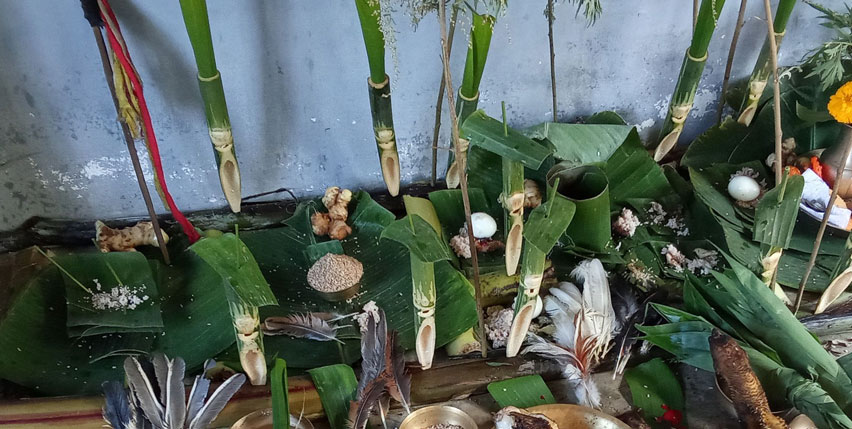
At its center are Puchuk, conical sculptures made from grain flour reminiscent of the Buddhist Torma yet rooted in an older animist tradition.  These are delicately placed upon the leaves of the Nebhara fig tree or the broad fronds of wild banana. Above the shrine, Chellam, a thin liquid made from flour, is splashed against the wall, forming an ephemeral offering that mingles matter and intention. Petals of Totala Phool, the Indian Trumpet Flower, are placed as symbols of renewal and beauty, while items such as the Thurmi, a ritual dagger, are arranged with exacting care. A small oil lamp, known as pala or diyo, burns steadily, its flickering light guiding the spirits and illuminating the sacred space. Sang, fragrant juniper, is kindled, sending smoke that is believed to cleanse and invite divine presence. Five eggs are placed on the shrine, offered to the guardian spirits, Baarah, Chirkun, Jaleswori, combined protective ancestral spirits, and one specifically to Lamadabla, symbolizing fertility, protection, and the shaman’s ongoing connection to the spiritual and ancestral realms.

And alcohol, specifically locally brewed Raksi, is poured as a libation to spirits and ancestors. At the appropriate moment, a chicken is ritually sacrificed, its blood offered to the deities to complete the transaction between the human and spirit realms. The entire space is activated through the sound of the Takey, the ritual drum, whose deep resonance propels the shaman into trance.

Among Thami shamans, the Takey, their ritual drum, is often a treasured inheritance, passed down through family lines or granted by a mentor who recognizes the calling.  However, the shaman’s arsenal extends beyond this resonant instrument to include the sharp blast of the Mirkang, a trumpet fashioned from tiger bone, and necklaces adorned with bells and the vertebrae of snakes, each carrying its own power and symbolism. Yet, above all, the most essential tool remains the Thurmi, known more broadly as the Killa, a ritual dagger that serves as a symbolic nail, anchoring the shaman’s authority and binding the unseen forces that swirl around the ritual space.

The Thurmi stands as the shaman’s axis of power, a ritual blade that carries within it the memory of ancestral authority. Made of metal or bone, it gathers the strength of the elements and the breath of those who wielded it before. In the course of the ritual, the Guru Apa uses the Thurmi to fasten energies that move unseen, to steady the currents of the spirit world, and to affirm the balance that holds the human and the other-than-human in relation. Its point fixes intention, its presence marks the center of the sacred ground. Through the Thurmi, the shaman engages in a dialogue with the invisible, a necessary act of anchoring, binding, and remembering that maintains the equilibrium of the world.

Thurmi

The shaman, endowed with privileged access to the divine realm and guided by knowledge transmitted through ancestral memory and spirit tutelage, occupies a position of extraordinary responsibility within Thami society. Through experience, inherited ritual authority, and the use of sacred instruments, the Guru Apa becomes an agent of mediation who renders the invisible legible. In ritual practice, the shaman restores equilibrium between human and nonhuman worlds, aligning social harmony with ecological and spiritual order. What might appear as acts of healing or divination are, in essence, ontological interventions. They create moments in which the moral, natural, and ancestral planes are brought into coherence. Within this worldview, shamanism becomes a sustaining cosmology, a way through which the Thami continually reproduce their understanding of balance, reciprocity, and existence itself.

Despite the encroaching forces of modernity and the gradual transformation of social and economic life, the figure of the shaman endures as a repository of Thami cultural memory. Through ritual knowledge, oral transmission, and embodied practice, the Guru Apa preserves the ethical and cosmological foundations that continue to define Thami identity. Shamanism, resilient yet adaptive, remains central to how the community negotiates change, anchoring collective belonging through enduring traditions while sustaining a system of meaning in which the sacred and the social are inseparable.

Magar Weddings: Rituals of Kinship and Social Balance

The Magar marriage system serves as a central institution within Magar society, reflecting both enduring rituals and diachronic transformations shaped by shifting social and cultural contexts. Marital practices such as cross-cousin marriage and clan-based exogamic taboos articulate cultural norms that shape kinship ties and uphold the social boundaries of the Magar community. In traditional Magar culture, marriage is a public, ancestral, and communal institution instead of a mere dyadic romantic union. These practices underscore the collective nature of marriage, positioning it as a mechanism for social reproduction and cultural continuity across generations. In this way, marriage among the Magars operates as both a form of negotiation and reinforcement of identity, integrating individual choice within broader communal imperatives.

Historically, cross-cousin marriage lay at the heart of Magar matrimonial alliances. A preferred pattern involved a man marrying his mamacheli, the daughter of his maternal uncle. This union was a practical arrangement and a culturally sanctioned ideal that reaffirmed long-standing ties between wife-giving (Maiti) and wife-receiving (Kutumba) lineages. If the preferred mamacheli was unavailable, a younger girl from the same maternal line could still be considered. Such relationships were encouraged from a young age, often expressed through playful teasing and familiarity, which functioned as a culturally recognized courtship dynamic. In sharp contrast, marriage with a phupucheli, the daughter of one’s paternal aunt, was strictly prohibited. This distinction underscores a deep moral architecture within Magar kinship, where certain forms of closeness are celebrated and others considered transgressive. Moreover, reciprocal marriage between the same two lineages across generations, where a wife-giving clan becomes a wife-receiving one, is regarded as a violation of social balance, tantamount to incest within Magar ethical reasoning.

As society changed, so too did the forms of marriage. New ideas brought through education, migration, and state influence softened older certainties. Yet even with evolving practices, the underlying principles of lineage continuity and clan exogamy remain central. A marriage in Magar culture and tradition is as much a ritual transaction between families as it is a personal choice. It links households, affirms social responsibilities, and reestablishes relationships between clans. Ritual acts such as offerings, blessings, and assigned roles during ceremonies reflect a worldview in which personal unions are deeply embedded in collective identity.

Traditionally animist and later shaped by Hindu and Buddhist syncretism, Magar society maintains strict rules of clan exogamy. Marriages are prohibited within the same thar (clan), a rule intended to ensure genetic diversity and uphold ancestral boundaries. Kinship is both genealogical and spiritual realities. In the Kham Magar regions of the Atharah Magarat, shamans known as Ramma are regularly consulted before a marriage takes place. Their role is to sense spiritual disturbances, interpret ancestral signs, and ensure that the union aligns with unseen forces. Within this worldview, marriage carries meaning that extends beyond the material or personal. It forms a bridge between generations, links the household to the realm of spirits, and affirms the individual’s place within the larger social and cosmological order.

Among the Magars, marriage functions as more than a personal union between two people; it acts as a reaffirmation of social order, lineage continuity, and ancestral connections. Arranged marriage, known as Lagañya, stands as the most widely accepted and ritually endorsed form. Elders take the lead in these unions, relying on memory, clan ties, and perceived compatibility to negotiate the match. Engagements include exchanging symbolic offerings such as locally brewed alcohol, betel nut, and livestock, followed by rituals that unite two individuals as well as their kin groups. These alliances are carefully crafted, respecting rules of clan exogamy and reinforcing established social boundaries.

Elopement or love marriage (Odañya), represents a shift in generational attitudes. Couples who elope without prior approval often return later to seek ritual recognition and family reconciliation. Although once viewed as transgressive, these unions have gained increasing acceptance, especially in areas influenced by education and urban lifestyles that emphasize autonomy and love. Still, the reconciliation process remains vital. It involves offerings, dialogue, and the construction of a new consensus founded on retrospective acknowledgment of the couple’s decision rather than prearranged negotiations.

Additional forms of union add complexity to the marriage system. Capture marriage, referred to as Jari Biha in Nepali, and levirate marriage, Bhauju Biha, were once part of the social fabric but now mostly survive as remnants of earlier times. Jari involved taking a woman, sometimes with consent, sometimes without, accompanied by ritual compensation to her natal family. Levirate marriage involved a younger brother marrying the widow of his elder sibling, ensuring economic continuity and preserving kinship roles. These practices, though still present in some isolated areas, now occupy marginal positions in Magar ritual life and lack the formal recognition accorded to Lagañya or Odañya.

While native terms exist for arranged and elopement marriages, others often lack indigenous labels. This absence has led some to question whether practices like jari, levirate, or symbolic cohabitation are originally Magar or borrowed from dominant cultures over time. However, such views risk ignoring the realities of cultural change. In oral societies, language loss and assimilation are common, and the absence of specific terms does not mean practices have vanished. Instead, customs are lived through daily habits rather than always being explicitly named.

In areas such as the Barah Magarat, where Nepali has replaced Dhut in everyday speech, many native expressions have faded even as the social structures they described endure. Although Jari Biha is a Nepali term, the practice of restitution in disrupted marriages reflects Magar values of balance, reciprocity, and social healing. Authenticity here depends less on linguistic purity and more on whether the underlying values and relational principles continue to embody a distinctly Magar worldview.

In Magar marriage rituals, symbolic actions and material offerings are central to affirming social relationships, ancestral blessings, and communal legitimacy. Alcohol, particularly Lee (Jaad or Rice Beer) and Mudd (Raksi or Traditional distilled spirit), serves a dual role as both a celebratory drink and a ritual object imbued with cultural significance. During matrimonial negotiations, the exchange and consumption of alcohol carry layered meanings. For example, when a marriage proposal is presented, the groom’s family offers alcohol in a wooden container called Koriya to the bride’s family. The acceptance of this offering signals agreement to the union, while refusal requires the return of any initial gifts (often doubled) in a practice known as Sahi. Certain types of alcohol hold specific ceremonial importance; a three-day fermented rice beer, Jahman, is traditionally given to wedding guests and the groom’s party as a symbolic blessing before their departure. Across many regions, especially in western Nepal, alcohol is the preferred medium for hospitality and ritual purity, at times taking precedence over other customary offerings such as yogurt or curd.

Symbolism in Magar marriage extends beyond material offerings to include spatial arrangements and ritual performances. In the bride’s natal home, she is accorded a position of honor, seated to the right and receiving the Tika, a ritual blessing made with rice grains applied to the forehead, before the groom. This order is deliberately reversed after marriage, signifying her incorporation into her husband’s lineage and the resulting shift in kinship hierarchy. In cases of elopement, reconciliation rituals known as Sodhni require both bride and groom to present jars of alcohol to the bride’s family, affirming mutual consent and restoring family relationships. Collectively, these ritual elements sustain the Magar marriage system’s connection to ancestral cosmology, weaving together domestic life, community values, and spiritual order.

Marriage rituals are elaborate affairs among the Magars, functioning as structured processes of kinship affirmation and social legitimacy. From the outset, the role of the Lami (marriage intermediary) is vital. The Lami, often a maternal uncle (Mama) or a sister’s husband (Jwaaichela), delivers the marriage proposal along with Sagun, a symbolic offering comprising items like Raksi (distilled alcohol), Tarul (yam), honey, and money. Acceptance of the Sagun signifies consent to the union, while refusal halts proceedings. In many regions of Central-West Nepal, only an odd-numbered group of male relatives accompanies the proposal, and the offering is reciprocated by the bride’s family through a second set of Sagun, thus formalizing the engagement in a reciprocal framework.

The ritual of bringing the bride to the groom’s home (behuli bhitraune) is central to the marriage process and is marked by spatial and symbolic rites. Before entering the house, the bride sets down a water-filled Amkhora (brass jug) at the threshold, symbolizing purification and auspicious entry. A rooster is sacrificed near the doorway as an offering to ancestral spirits and for spiritual safeguarding. The bride carries the jug inside and pours a few drops onto her mouth, marking her acceptance into the new household. In some areas, Chamal Tika, made of Dahi (curd) and Chamal (rice grains) is applied to the foreheads of both bride and groom by elder kin, beginning with the bride. This reversal of ritual order before and after marriage signifies the transition from natal to affinal kinship, and the shifting roles and status the bride undergoes. The application of tika, tying of Dubo-Paati (sacred wheatgrass and leaves), and collective feasting all contribute to affirming the union within the wider social and spiritual order.

In cases of elopement (Odañya), reconciliation rituals such as Sodhni serve to reintegrate the couple into normative kinship structures. Within three days of elopement, the groom’s party is expected to bring Raksi (distilled alcohol), Roti (traditional bread), and Jaaḍ (rice beer) to the bride’s family to seek retroactive approval. Failure to do so invites social sanction. The ritual offering signals accountability, respect for lineage, and the mending of relational ruptures. A further ritual, Chorkorya, involves delivering the right foreleg of a previously sacrificed goat or buffalo, kept aside during the behuli bhitraune, as a token of symbolic completion of the marriage process. This act serves as a restitution and also as an embodied communication of ritual closure and reparation.

The final phase, Janti jaane (bridal procession), represents the public legitimization of the marriage and involves exchange, gifting, and symbolic hospitality. On the day appointed by the bride’s family, the groom’s party arrives with ceremonial gifts, called Danda or compensation: a minimum of five containers of raksi, hundreds of Roti, live animals, and women’s traditional garments. These offerings are meant to reduce the economic burden of the bride’s family and to honor reciprocal ties. During this event, relatives perform reciprocal Dhogbheṭ (gestural greetings), and elders introduce the bridegroom to the extended kin. The wedding concludes with a communal feast and singing, often lasting up to three days.

Magar culture considers marriage functions a calibrated system of ritual acts to shape and stabilize shifting kinship ties. These rituals, while diverse across regions and responsive to social change, continue to serve as vital expressions of communal identity, ancestral reverence, and relational ethics. Each gesture carries a symbolic weight that extends far beyond its surface form. These acts do not operate in isolation but are woven into a broader ritual grammar through which households, lineages, and ancestral obligations are continuously aligned.

Even as external influences reshape certain customs, the underlying principles of reciprocity, clan respect, and ritual coherence persist, anchoring marriage as both a cultural continuity and a living tradition. Through this process, the institution of marriage emerges as a dynamic field where memory, belonging, and cosmology are enacted and renewed.

Beyond Silence: Exploring the Mysterious Kusule

In Darjeeling and Sikkim, one can rarely find a person who hasn’t seen a figure cloaked in intricate headgear, adorned with Rudraksha beads, deftly playing the hourglass-shaped drum (Damaru). Emerging from obscurity, he would vanish as mysteriously as he appeared, after having received alms. As children, his presence and attire both fascinated and unnerved us, stirring our imaginations. Known to our parents simply as “Kusule,” he upheld an unwavering vow of silence, shrouding himself in an aura of mystique that left us longing for answers that we never found.

The Kusule, also known as Kusle, Kusulya, Jugi, or Kapaali, are ritual specialists who occupy a unique and often marginal position within the stratified social hierarchy of the Newar community in the Kathmandu Valley. Traditionally ascetic, they follow a path of renunciation that places them at the edges of social life, yet their spiritual role grants them a distinctive authority. This combination of marginality and influence reflects the complex ways in which Newar society negotiates boundaries between the sacred and the social.

Newar social structure is characterized by a finely layered caste system, intensely influenced by both Hindu and Buddhist cosmologies. Within this intricate framework, the Kusule occupy a distinctive niche. They serve as ritual musicians and ceremonial functionaries, particularly in rites associated with death, spirit possession, and purification. Their ritual authority derives in part from their perceived proximity to the liminal: the threshold spaces between life and death, purity and pollution, revered and profane.

Their practices and iconography reveal historical affinities with heterodox sects such as the Kapalika and Gorakhnathi, esoteric traditions known for their austere, tantric disciplines that transgress normative religious boundaries. Yet, the Kusule remain firmly situated within the ritual economy of the Newar world. Far from being outsiders, they are an enduring part of a religious system that embraces both conformity and defiance in its ceremonial practices.

The name Kusle derives from Kus grass (Desmostachya bipinnata), a sacred plant regularly used in South Asian ritual traditions. This simple blade of grass carries powerful symbolic weight, linked to creation myths and purification rites. Additionally, Newar folklore traces the Kusule lineage to Kusalnath, one of the twelve disciples of the tantric master Gorakhnath, connecting the name to an ancient yogic tradition. Another story recounts how a Kapaali ascetic earned the title Kusle by being the swiftest to bring Kus grass to King Sthiti Malla, thereby establishing the name as an honorific within ritual circles. Thus, the term Kusule embodies both botanical symbolism and a historical lineage deeply rooted in ascetic and tantric traditions.

Kus grass (Desmostachya bipinnata)

Inscriptions and historical texts from the Kathmandu Valley offer a window into the early presence and ritual importance of the Kusle-Kapaali within Newar society. As early as the 14th century, records point to figures closely aligned with Nath traditions (a Shaiva tantric yogic tradition rooted in asceticism and Hatha Yoga). An inscription from Itum Baha in 1382 mentions a minister devoted to Gorakhnath, while a 1390 record from Pharping documents the installation of Gorakhnath’s footprints by a yogi named Achintyanath, providing evidence of a spiritual landscape shaped by ascetic lineages. By the mid-15th century, inscriptions at the Kasthamandap shrine refer to ritual practitioners called Darsandhari, an early designation for the Kusle, who performed Chakrapuja, a complex tantric offering rite. These accounts suggest that the Kusle were once central figures in the Valley’s religious life, occupying sacred spaces where esoteric knowledge and public ritual converged.

Legal and social classifications in later periods reveal how the Kusle’s status shifted over time. The 1853 Muluki Ain, Nepal’s legal code under the Shah dynasty, lists the Kusalya among castes assigned to ritually impure roles, essential, yet socially marginalized. Earlier references by scholars and travelers, including D.R. Regmi and Francis Hamilton, describe communities known as Kusulay, Darsandhari, or Kasulia, serving as musicians, mendicants, and temple assistants. Their ritual authority, once affirmed through public ceremonies and temple affiliations, gradually diminished as royal patronage favored other ascetic orders, particularly the Kanphata (Kaan Chireko) Jogis. Yet the textual and epigraphic record preserves the imprint of their legacy as a social group rooted in Tantric traditions, once entrusted with navigating the spiritual boundaries of death, impurity, and transformation.

In contemporary practice, the Kusle occupy a pivotal role within the ritual landscape of the Newar community, primarily engaging in rites associated with death, purification, and spirit appeasement. As ritual specialists in mortuary practices, they oversee the preparation of corpses for cremation, conduct transitional ceremonies that facilitate the safe passage of the soul, and enact protective rites aimed at shielding both the deceased and the living from spiritual disturbance. These performances draw upon a repertoire of symbolic gestures and embodied knowledge rooted in Tantric cosmology, particularly those concerned with the containment of liminal energies and the pacification of potentially disruptive forces or ‘energies’. Positioned at the interstices of life and death, purity and danger, the Kusle serve as ritual mediators, navigating thresholds where the social order is most vulnerable to rupture.

A distinctive ritual unique to the Kusle involves a family member who, during the four winter months, from Bala Chaturdasi (mid-Mangsir) to Bikram Samvat New Year’s Eve (Chait), dons the appearance of Shiva. Covered in ashes, adorned with the Tripundra (three horizontal lines) on the forehead, wearing a diadem symbolizing the divine mothers, and necklaces of Rudraksha beads and human bones, a Kusle walks through the city streets at dawn carrying a hour-glass (damaru) drum. This procession is meant to expel harmful forces and purify the community, reinforcing their connection to Shiva and their role as powerful exorcists. Silence during these ceremonies further emphasizes their intimate relationship with the “dark” forces, serving as a ritual bridge that controls malevolent spirits without spoken words.

Kusle Burial Site in Kaldhara, Kathmandu

Among the Kusle, death rituals are shaped by a distinctive Tantric Shaiva worldview. Unlike other Newar castes that practice cremation, the Kusle perform inhumation, placing the deceased in Padmasana (seated meditation posture) facing north, toward Mount Kailasha, the mythic abode of Shiva. The ritual is conducted by a Kusle guru, who recites the mantra of Gorakhnath and performs Mṛitadikṣa, a post-death initiation meant to guide the soul, especially for those who died uninitiated. The burial mound is shaped as a Linga (sacred Shiva symbol), and ritual offerings are placed at four points: Kaagbali (for the crow), Pretbali (for the wandering soul), Svanbali (for the dog), and one for Gorakhnath himself. In the days that follow, the family performs Laapuja, a series of offerings involving water, rice, yogurt, vermillion, sesame, and flowers—first to Gorakhnath and then to the others. Through these rites, the Preta (the restless spirit of the recently deceased) is ritually transformed into a Pitr (an ancestral spirit acknowledged and venerated by the living).

Initiation into the Kusle tradition reflects these same liminal values. The process is led by a guru and includes the transmission of Gorakhnath’s mantra, an anointing with Panchagavya (five cow derivatives) a, and a symbolic Karnavedha: a ritual ear-piercing that gestures toward their ancestral link to the Kaanphata Jogis, though the ear is not actually split. The initiate is marked with ash and the sacred syllable Aum, and then enacts a symbolic journey to Varanasi, walking a path made of flour, cloves, and leaves laid out by the guru. This performance stands in for physical renunciation, signaling inner transformation within a household setting. Daily worship continues through a modest attic shrine to Gorakhnath, where offerings are made and roti (ritual bread) is prepared weekly. The Kusle’s ritual life, deeply embedded in Tantric practice yet adapted to Newar caste society, preserves a vision of sacred duty centered ritual mastery of its boundaries without impeding social perimeters.

Gorakhnath

In their social life, the Kusle occupy a distinctive position within Newar society as ritual musicians, traditionally responsible for playing sacred instruments during death rites and other ceremonies involving ritually impure forces. In the context of funerary practices, their music transcends mere performance; it becomes a medium of spiritual transformation, guiding the soul of the deceased while purifying the environment for the living. Their expertise in navigating the symbolic weight of death through sound marks the Kusle as custodians of a liminal domain where the sacred and the unclean converge.

Yet despite their indispensable ritual function, the Kusle remain socially marginalized. Their constant engagement with death and impurity, while vital to communal order, assigns them a low-caste status within the Newar caste hierarchy, subjecting them to social stigma that restricts both mobility and economic opportunity. In response to these constraints, many have adopted tailoring as a supplementary occupation which has become an adaptive strategy that complements their ritual role while providing a modest livelihood. This quiet fusion of sacred duty and secular labor reflects a resilient navigation of a world that relies on their presence yet offers limited recognition in return.

Many people confuse the Kusle with the Kaanphata Jogis, but the two are markedly different in both lifestyle and social integration. While the Kusle are linked to the Nath tradition and share certain symbolic and ritual features with the “split-eared” Jogis, such as associations with Shivaite tantra and practices around death, their paths diverge in significant ways. The Kaanphata Jogis live lives of strict asceticism, distinguished by physical signs of devotion like their split ears, which hold symbolic earrings of their sect. These ascetics typically renounce household life, travel widely, and position themselves outside the caste-based social systems of settled communities, following a rigorous path of personal spiritual discipline.

The Kusle, by contrast, have localized and adapted Nath traditions into the structure of Newar society. Rather than renouncing worldly life, they maintain family ties and fulfill hereditary ritual duties, including conducting funerary music, exorcisms, and rites surrounding death and impurity. They do not bear the marks of extreme asceticism, nor do they detach from community life. Today, the distinction is even more apparent. Since the Kusle are ethnically Newar, speak Nepal Bhasa (Newari), and embody Newar cultural identity. The Kaanphata Jogies whether celibate ascetics or born into the Jogi caste, are Parbatiya, aligned with the broader Indo-Nepalese Hindu framework and often affiliated with major Shivaite centers like Varanasi, Haridwar, and Kedarnath.

The ritual muteness of the Kusle is deeply symbolic, reflecting their role as intermediaries between the living and the spiritual realms. In Newar death rituals, where they handle potent forces associated with death and the spirit world, silence serves as a protective and purifying measure, allowing them to perform their duties without directly invoking or disturbing malevolent energies. Muteness aligns them with the Preta or wandering spirit, a being in transition and often unsatisfied, symbolizing the dangerous and unresolved aspects of death. By remaining silent, the Kusule embody a restraint that controls these forces, reinforcing their role in “containing” spiritual disturbances within ritual spaces. Silence thus becomes a shield that separates them from direct confrontation with these forces, allowing their presence to perform exorcistic functions subtly and effectively without verbal interaction.

In the shifting landscape of contemporary Himalayan region, the Kusle stand at a fragile crossroads, their ancient role as ritual musicians and death workers steadily dissolving into the margins of memory. Once bearers of sacred sound and mediators between realms, they now face growing irrelevance in a society that increasingly turns to sanitized forms of ritual and forgets the necessity of those who navigate the liminal. Modernity has offered few concessions as tailoring and low-paying labor now supplement their ritual services, but these new roles bring neither dignity nor security. Despite deep cultural lineage and societal importance, the Kusle continue to face caste-based stigma, economic hardship, and a fading recognition of their spiritual authority.

Nonetheless, their presence evokes something more enduring than marginalization. The Kusle embody the living palimpsest of Newar civilization, layered with influences from different traditions and cosmologies. Today, as the valley of Kathmandu modernizes and ritual worlds fragment, the Kusle’s quiet resilience reminds us of an older truth: that those who dwell closest to death often guard the deepest knowledge of life. To listen to their Damaru beat is to hear the echo of a civilization in dialogue with its own spirt.

The Sunuwar Kõits and Their Ancestral Identity

For the Sunuwar Koits, history isn’t inscribed on parchment or pressed between the pages of books. It is carried in the stories of elders, held in the ritual chants, and guarded by shamans who traverse the liminal space between the physical and the unseen. Their myths of origin, their ancestral lineage, and the their traditions have only passed through the living memory of their people. Very little has been written about the Sunuwars, apart from a handful of books and academic papers. Among them, People of Nepal (1967) by Dor Bahadur Bista stands out where he speaks of twelve clans, the Bara Thars, mapping the Sunuwar presence along the watersheds of Likhu Khola and Khimti Khola, within the vast embrace of the Sun Koshi basin.

For the Sunuwar Kõits, identity has always been embedded in language and in the subtle architecture of words that give it meaning and purpose. Their name, Kõits, is drawn from the verb kõincha (kõitsā), meaning “to guide” or “to show.” It carries a sense of leadership that has been shaped by tribal hierarchy, and the reverence for the elders and traditional wisdom, where guidance is an act of understanding as well as survival. The word “Sunuwar,” was given by Nepali speakers and tied to the western banks of the Sunkoshi. However, it does point out to their geographical location and hints at how outsiders perceived and categorized them through place rather than through their own sense of belonging.

Furthermore, the Kõits identity has long been overshadowed by colonial constructs, with terms like “Sunuwar” and “Mukhiya” reducing a vibrant heritage to geographic or administrative labels. These exonyms, born of Indo-Aryan linguistic frameworks, strip the Kõits of their nuanced self-definition, while framing them within external perceptions of land and power. This has, in some sense, undermined their rich, self-constructed ethos. Nevertheless, the endonym Kõits has endured as a linguistic and cultural anchor, and defied the erasure of their heritage. It reminds the community of their deep historical ties to leadership, their indigenous lexicon’s capacity to preserve meaning, and the resilience of their ethnic identity. In reclaiming the term ‘Kõits’, the community reasserts a sovereignty of meaning, celebrating their role as custodians of ancestral wisdom.

The Kõits stand as inheritors of an ancient Kirati lineage, their lives bound to ancestral and shamanic devotion, along with an abiding kinship with the land. For them, every custom, rite, and daily life mirrors a profound attunement to both the natural world and the unseen forces that animate it.

The Bara Thars, or clans, serve as genealogical markers that define Sunuwar identity. Each clan branches into several subgroups that, despite their diversity, remain connected through a shared system of kinship and intermarriage. Some of these clans are Binicha, Bigyacha, Bujicha, Bramlicha, Darkhacha, terms that are remnants of an older wisdom, linking families to lost professions, forgotten geographies, and elemental truths. Some, like Phaticha, meaning “to filter,” speak to the ancient crafts of purification and separation, while Gongrocha— “to open noisily”—evokes the sharp report of thresholds crossed, of doors flung wide to new horizons.

The following are some of the Kõits clan names of Thars

  • Binicha
  • Bigyacha
  • Bujicha
  • Bramlicha
  • Darkhacha
  • Dasucha
  • Debbacha
  • Digarcha
  • Durbicha
  • Phaticha
  • Gaurocha
  • Gongrocha
  • Jespucha
  • Jijicha
  • Jenticha
  • Katicha
  • Khunlicha
  • Kyabacha
  • Khyonpaticha
  • Kyuinticha
  • Kormocha
  • Laspacha
  • Linocha
  • Lonkucha
  • Lunkicha
  • Mulicha
  • Nasocha
  • Ngawocha
  • Nomlicha
  • Pargacha
  • Pretticha
  • Rapicha
  • Rawacha
  • Rudicha
  • Rujicha
  • Rupacha
  • Shyochulcha
  • Susucha
  • Teppacha
  • Thangracha
  • Tholocha
  • Tonkucha
  • Thungucha
  • Tursucha
  • Wangdecha
  • Yatacha

Their language, casually termed Sunuwari, is actually called Kõits Lo. It is a branch of the Tibeto-Burman family, and serves a vessel of memory, a defiant marker of identity in a world that presses upon it, other than being a mere means of communication. Though the tide of Nepali influence and the weight of neighboring Hindu traditions have reshaped the cultural landscape, the Sunuwar remain steadfast, their language a thread binding them to the past, their ancestors, and to the land. This deep connection to the land is the foundation of their way of life. Agriculture dictates their rural existence, with terraced fields carved into the hillsides yielding millet, maize, and rice. Although hunters in the past, ingenious irrigation techniques have long been employed to foster abundance from the earth, yet the land itself is finite, its scarcity an ever-present challenge. Therefore, animal husbandry plays a lesser role, and has acted as a quiet supplement to an economy. In the fields, their unwavering traditions and in their language, the Sunuwar inscribe their history, ensuring that neither the soil nor the stories are ever lost.

Socially, the Sunuwar Kõits are organized into patrilineal clans that dictate familial lineage and social roles. Each clan has specific rituals that are performed to honor their ancestors, with a clear distinction between those who carry on the ancestral line and those who perform the rituals. Marriage within the Kõits society follows exogamous rules, ensuring that individuals marry outside their clan, which further reinforces their social cohesion and the interconnectedness of their clans. An interesting aspect of Kõits identity is their understanding of gender roles. In Sunuwar belief, ruysh (bones) are associated with male identity and patrilineal descent, while shey (flesh) represents the maternal lineage and female identity. This dualistic view of gender extends beyond social roles to their material and spiritual lives. For example, men inherit ancestral lands, which are seen as symbols of permanence, while women’s roles, though indispensable, are seen as transient in comparison.

Shamanism among the Kõits is both a spiritual practice and the axis upon which their world turns. Shamans are viewed as a sacred lineage of healers, seers, and intermediaries who walk the threshold between the living and the dead. To be a shaman is to wield Thung, an inherited power that grants the ability to heal, divine, and channel the voices of spirits. Rituals unfold in the flickering light of tradition, where bamboo, along with a host of other indigenous plants serve as the bridge between realms.

Sunuwar spiritual life is a delicate balance, a dual system upheld by the Naso, the elder who offers prayers and sacrifices, and the Puimbo or Ngiami, the shaman who traverses the spectral veil. Their rites are immersive acts and transform into ecstatic trances in which spirits speak, descend, and afflictions are torn from the afflicted. Shamans, once chosen by ancestral energies, work as an apprentice for experienced Shamans (Guru Thapnu) or are kidnapped by the mythical banjhakri, the forest spirit. The Banjhakri selects and initiates such novice Shamans, dragging them into the unknown, where the true apprenticeship begins. Through trials of endurance and revelations of power, the shaman emerges, armed with sacred incantations, divination rites, and the steady pulse of the drum.

In Sunuwar culture, gender symbolism takes on even more significance within the realm of shamanism. Sunuwar shamans, whether Puimbo (male) or Ngiami (female), transcend traditional gender roles and adopt an androgynous identity. This spiritual flexibility is crucial to their role as intermediaries between the living and the ancestral spirits. Shamans are believed to possess the power to enter trance states and communicate with the divine and the deceased, bridging the gap between the human and spiritual realms. This transcendent ability is facilitated by their unique gender identities, allowing them to embody the balance between masculine and feminine forces, a theme that is also evident in the Sunuwar’s material culture.

The forces of modernity, migration, urban expansion, the pull of mainstream education have, to an extent, eroded the foundations of Kõits tradition. Yet culture is not so easily erased. In villages and diaspora communities alike, a quiet resistance still takes shape. Grassroots movements emerge, language revitalization efforts take root, and ancestral knowledge passes from elders to youth. Among the youth, festivals have little events to rejuvenate ethnic consciousness. They serve as reaffirmations of a way of life that refuses to fade. Though the tides of change press in, the Sunuwar Kõits continue to hold fast, ensuring that their heritage is remembered and lived. Now, it falls upon the younger generation to bear this weight, to carry forward what remains, as a privilege, and also as a birthright.

Chongkha Sakenwa of the Bantawa Rai people

Bantawa Rai of the Amchoke region have a unique way of celebrating the yearly Ubhauli or Dongwanga (Beginning of monsoon and plantation).

According to legend, Khuirum Hangkhim and Namnu, who were related as son-in-law and father-in-law once chased a wild boar, which was eventually struck by their arrows at Mayung Lake (present-day Bhojpur). After the fatal strike, the boar fell to the ground and transformed into a stone in the shape of a deity, which became attached to a Gagun tree (Saurauia nepalensis). The boar was a forest deity in disguise, which they recognized as a Maang (deity) in the form of Sakenwalung, believed to bring great fortune to their village. This made them gather things for worship like ginger, water and Rice grains. After carrying out necessary rituals for the deity, Namnu requested the deity to come along with them to their village, and so the deity agreed.

They were overwhelmed with happiness and placed the Sakenwalung in their Thumsey (traditional wicker basket), dancing and singing. On their way home, at Chabung Buktang, east of the Bungwa River, Khuirum Hangkhim slipped, and the Sakenwalung fell from the Thumsey, getting impaled into the ground. After multiple attempts to remove it, they were unsuccessful and concluded that the deity had decided to stay there forever. They then placed other necessary items of worship and made it the Chongkha Sakenwa Than, a shrine where the people of the region could come for the annual worship of Mother Nature.

This story reveals the origins of the Chongkha Sakenwa Than. A recent discovery uncovered a giant brass bell dating back 200 years, said to be one of the oldest pieces of evidence that shapes the history of the Chongwa Sakenwa Thetlum (Than or Shrine).

Present day Mabjok region.

Above the Dudh kosi river, present day Dhintang, Chimawa, Bayang, Siddhathan were the areas of Mangpahang Bantawa living in 12 villages and the River Bungwa Hongku presently flowing in the Amchoke region. It covers the borders of Khotang and Bhojpur, runing between them. The Chongkha Sakenwa than is present in the Khotang side above the Bungwa river which borders Bhojpur.

These days Chongkha Sakenwa is specially celebrated by Khambu Rai of Amchoke region like Mangpahang, Hangkhim and Tanglukwa. Their 10 groups of generation are the ones who still carry out the traditional way of performing Chongkha Sakenwa.

10 elders from each 10 lineages who are also the head shamans of their respective branches, are often referred to as the 10 pagari or 10 Kirat who are the leaders of the overall region in both social, economic and spiritual issues.

They are named according to their age and designation like Jetha, Maila, Saila, Kaila1, Kaila 2, Thaila 1, Thaila 2, Thulo Kancha, Sano Kancha and Kancha. They have respective villages where they live with their own family like Namanta, Dambarkha, Chongkha, Dhangkha, Bhopung, Khawa, Makhuwa, Chumarang, Bhir Goan and Wasingthapu.

Chongkha Sakenwa takes place between the months of Jeth and Mangsir, after the monsoon has already begun. People are filled with excitement for their annual celebration, preparing food items, drinks, and roosters for sacrifice in advance.

On the first day:

Yamang tonma: It’s the day when the people ask for water to the deity of Sakenwa than, on Monday of Baishake Purnima. On this day all the 10 pagari or the Nachong(priest) take bath, and take out all the items that were kept safely after the last winter celebration of Udhauli. The entire family collectively moves toward the Sakenwa Than, playing the Dhol (Drum) and Jyamta (Cymbals). All 10 pagari from each family meet along the way to the destination, with some arriving early. Once all 10 pagari Nachong have gathered, the worship begins. After all the rituals the liquor that is brought is served to everyone, which ends the 1st day.

One month later:

Khalappa mang or Bhumi Puja: is carried out in respective Pagari’s land to please the deities before the grand celebration. All the villagers bring Hengmawa/Raksi (traditional alcohol) for offering, which is later distributed in between the people. And money is also collected from everyone for the celebration of Chongkha Sakenwa. All the expenditures are calculated and plans are made on this day.

Day before the celebration:

After Jeth and Mangsirey Purnima, the following Saturday, all the houses in the village is cleansed and Diwa Puja or Ancestral worship is performed. All the Dhol (traditional drums) and Jyamta(cymbals) are taken out by the Nachong and is washed and dipped in water of the nearby stream or creek for one night. Next day the animal skin is replaced by a new one, and all the items are cleansed by the Nachong to be used.

Sohan chakwa or pure water from the main source is used to perform all the cleansing works. The Samkhalung/Teen Chula (Hearth Stones) is worshipped and all the ancestors are remembered. Mundum is chanted for overall improvement with a sacrifice of a Rooster.

After the work in the house the villagers move towards the part of the hill which falls under the land of the Nachong in all the 10 pagari villages. Dewa Puja is the rituals performed in the land of each 10 pagari. Where all the instruments are taken out and Semuna silli or Sakenwa Lakcham of Bantawa Rai is performed. And after the worship all the villagers move to their houses for the preparations for the next day.

Main day:

All the Nachong take ritual bath and all the roosters are also washed which are ready for the sacrifice on the main place. All families in the village pray for overall welfare of the family and society.  In their specific villages the Nachong is congratulated and his Sayachongma (head raising ceremony) is done by the villagers.  Then everyone moves towards the Sakenwa than playing the Dhol and Jyamta dancing along the way. The whole atmosphere of the region becomes very pleasant.

A special dance form of the Bantawa Rai called Sakenwa Lakcham is done by everyone present and upon reaching the place all the drummers walk inside the Sakenwa than playing the Dhol by which it is believed that the negative spirits residing in that place is scared by the sound and wards off. Then all the 10 pagari according to their age and designation perform all the religious works and offer sacrifices to the deity. Turn wise all the 10 pagari finish the work and the people are then allowed to perform offering rituals.

After all the religious work, everyone dances the Sakenwa Lakcham with great energy and happiness ending the celebration of Sakenwa. Then on that same day, 3 km away from the Sakenwa than a big annual fair is carried out called the Mangsirey Mela, which the locals visit after the celebration till end of the day.

Chasok Tangnam: The Limbu Harvest Festival

Cultural festivals provide one of the few consistently affirming opportunities for indigenous communities in the Himalayas to strengthen and assert a more constructive self-image, both across generations and in the pursuit of their identity as a distinct culture. For the Limbus, the harvest festival of Chasok Tangnam serves a similar purpose. It represents both a profound connection between nature and spirituality and also acts as a protector of their rich cultural heritage.  Rooted in the Mundhum (the oral scripture and traditional philosophy) Chasok Tangnam is a celebration of gratitude and ecological reverence.

Chasok Tangnam is celebrated during the Udhauli season, which typically occurs in late autumn, in either November or December. This season marks the time of harvest when crops such as millet, rice, and buckwheat are gathered, aligning with the natural cycle of crop maturity. The festival thus coincides with a time of abundance and gratitude reflecting the agrarian values of the Limbu ancestors. The ritual of seeking permission from ancestors or nature to partake in the newly harvested crops is called ‘Chasok,’ whereas ‘Tangnam‘ translates to festival or celebration.

As an indigenous community of the Eastern Himalayas, the Limbu have long relied on farming as their primary means of livelihood. The Mundhum narrates the shift from a foraging to an agricultural society, facilitated by divine intervention.

In ancient times, during the era of Sawa Yethang, the earliest human ancestors relied on gathering wild fruits, roots, and tubers for survival. This fragile way of life eventually led to health problems, prompting them to seek divine intervention. Tagera Ningwaphuma, the creator of the world, answered their prayers by imparting the knowledge of agriculture. Sibera/Sikera Yakthungma, a wise and visionary woman, became a central figure in this transformative period. She cleared the land with wooden tools, sowed seeds, and guided the community in the practice of farming. The fertile plains along the Tamor River, now known as Nembo Yakwa Tesuma in Taplejung, are celebrated as the birthplace of this agricultural transformation. Following the first harvest, Sikera Yakthungma urged the people to offer a portion of their crops to nature and their ancestral spirits as an expression of gratitude, marking the origin of the Chasok Tangnam tradition.

These narratives, though mythological, display the socio-historical development of the Limbu community. The roots of the festival lie in the ancient practice of Nwagi, the ritual of offering newly harvested crops to deities and ancestors before human consumption. Over time, this practice evolved into the collective celebration of Chasok Tangnam.  The practices and metaphors that weave the life cycle of crops into cosmic, human, and social dynamics reveal how a community harmonizes applied knowledge, symbols, and rituals into an evolving cycle of meaning. This cycle adapts over time and grounds essential processes within the realms of physical life, the household, the village, and the Limbu spirit pantheon.

Today, Chasok Tangnam is a multifaceted celebration that integrates spiritual rituals, communal gatherings, and cultural performances. The festival typically coincides with the harvest season, aligning with the natural cycle of crop maturity. The rituals are performed by Devari, Mangdemba, Fedangmas, and Yebas/Yemas (Limbu shamans), who act as intermediaries between the physical and spiritual realms.

Unlike many other communities, the Limbus do not directly embed farming practices into rigid religious symbols. Instead, they root these practices in tangible elements, such as crops, which are central to both practical and symbolic operations. In the context of Chasok Tangnam, this adaptability is evident in how harvested crops serve as offerings to nature and ancestral spirits, symbolizing gratitude and the cyclical harmony of life. Even as cultural and social landscapes shift, the flexible symbolism of plants and natural elements ensures that their relevance endures. Local knowledge about grains and other resources operates subtly behind these rituals, allowing traditions like Chasok Tangnam to continuously evolve while preserving their essence.

When crops like maize, millet, and rice mature, the household’s primary woman meticulously harvests the rice and millet ears. The rice is threshed, roasted, and processed into flattened rice (chura), while the millet is hand-husked, and its husks are combined with chili and water to brew Jaad Saaptok, a ritual millet beer.

A stalk of Malingo (Himalayacalamus asper) is planted in the ground, and a Muthareko Dhungro (hollowed bamboo vessel), approximately 5–6 inches long, is prepared. This vessel is filled with Saaptok and placed at the top of the Malingo. Waso Phungwet/Chindo (dried bottle gourd) or a brass pot is filled with Dawakama Wadumpakwa (pure water) for libations on the shrine. The ritual space is established by leveling the ground and laying out banana leaves to create a long ceremonial area. Altars dedicated to Yuma Sammang and Theba Sammang, the primordial ancestors, are arranged, with offerings placed on plates. A lit lamp serves as the final touch to complete the sacred setup.

The ritual honors several deities and divine spirits from the Limbu pantheon.

Misekpa: The first deity worshiped to ensure that the ritual proceeds without any obstructions or mishaps.
Kuikudap or Taphemba: A hunting divine spirit that ensures no obstacles in the household life.
Thungdangba: The Sun deity, worshiped to ensure favorable weather for crops.
Seebera/Sikera Yakthungma: A maiden who, having helped with the first seed sowing and ensured crop growth, is worshiped for support and life-giving assistance.
Kapobba Him Sammang: A deity who protects the home, often seen as a guardian ancestor.
Kashihangma: A female companion deity of Yuma Sammang.
Yuma Sammang: The supreme goddess of the Yakthung Limbu people, embodying the power of maternal strength, closely linked to the creation deity Tagera Ningwaphuma.
Theba Sammang: The male counterpart deity of Yuma Sammang, representing paternal strength and the ancestral male deity of the Limbu people.

The centerpiece of Chasok Tangnam is the Nwagi ritual, in which newly harvested crops are offered to Tagera Ningwaphuma, the ancestors (Samjik), and nature spirits. The offerings usually include millet, rice, and seasonal produce, symbolizing the community’s gratitude for a bountiful harvest. The rituals are held at sacred sites like Mangkhims (ancestral worship places) and natural landmarks such as rivers, caves, and ridges, believed to be inhabited by the spirits of ancestors and deities. The shamans invoke the spirits using traditional chants and rituals found in the Mundhum. Sacred drums (Tangsing) and other ritual tools are used to establish a spiritual connection.

Traditional Limbu dances, like the Dhan Nach, are an integral part of Chasok Tangnam, accompanied by folk songs that recount ancestral tales and cultural teachings. The festival is also marked by communal feasts, where the harvested crops are shared among community members, reinforcing social unity and collective well-being.

From an anthropological perspective, Chasok Tangnam serves as a crucial cultural institution for the Limbu community. It shows the anthropological concepts of reciprocity, sacred ecology, and cultural transmission. By offering the first harvest to deities and ancestors, the Limbu people acknowledge the interconnectedness of all beings and the cyclical nature of life. This act reinforces the community’s deep sense of stewardship for the environment.

The rituals of Chasok Tangnam emphasize sacred ecology, a key element of Limbu cosmology. Natural features such as rivers, caves, and mountains are revered as sacred spaces that house ancestral spirits. This sacred respect extends to agriculture, where practices like crop rotation, agroforestry, and the careful management of sacred lands help maintain a harmonious balance with nature. These sustainable methods ensure that the relationship between humans and the environment is regenerative and respectful.

In the modern context, Chasok Tangnam remains a deeply significant cultural and spiritual event for the Limbu community, even as it faces challenges from urbanization and globalization. Efforts to preserve the festival are ongoing, through documentation of the Mundhum, cultural education programs, and community outreach. As the Limbu diaspora grows, Chasok Tangnam has spread beyond its traditional regions, with Limbu communities in urban areas and abroad holding their own celebrations.

Ghatu Tradition of the Gurung People – Part 2

Part 1 of the article introduces Ghatu as a rich narrative song and dance tradition of the Gurung people, primarily performed in rural areas of Western and Central Nepal. It highlights its sociocultural importance, emphasizing its role in fostering social cohesion among the Gurung, Magar, and other communities. The Ghatu performance involves slow, trance-inducing dances that enact scenes from local mythology, particularly the story of Queen Amberwati and King Pashramu, with three main types of Ghatu: Barahmase, Kusunda, and Sati. The article also discusses the performance’s connection to agricultural cycles, particularly the belief that a successful Ghatu performance ensures a good harvest, and the ritualistic invocation of nature spirits during the performance. Read Part 1

Though Ghatu may appear at first glance as a traditional song and dance form celebrated for its elegance, fluidity, and the sustained grace of its physical choreography, it holds far greater significance from a cultural perspective. It serves as a deeply symbolic ritual, forging connections between performers and their history, environment, and spiritual beliefs. Beyond its aesthetic appeal, Ghatu functions as a source of cultural memory, a communal rite of passage, and a powerful expression of the Gurung worldview.

A typical performance can range from a few hours to several days. While the narrative content of Ghatu performances varies depending on the type performed, it usually begins with the invocation of the Ghatu Deuta, or spirits of King Pashramu and Queen Amberwati, key figures in the mythological narrative of Ghatu. The Guru, a figure of immense cultural and spiritual authority, chants mantras to summon these spirits into the bodies of the Ghatuli, the young female dancers. These dancers, chosen for their prepubescent purity, are believed to be uniquely capable of embodying divine energy. The trance state they enter is vital for the performance, signaling their role as intermediaries between the human and the divine. The trembling, closed eyes, and fluid movements of the dancers during the trance are viewed as signs of spirit possession, creating an intensely sacred atmosphere.

Guided by the Gurumas (female spiritual guides), the Ghatuli reenact mythological stories and also symbolize the connection between human vulnerability and spiritual transcendence. The dancers selected for these roles represent purity and sacred power, with their uncombed hair and Gurung Cholo (traditional dress) serving as symbols of their divine transformation. This unique interplay of ritual, gender, and spirituality challenges conventional patriarchal norms, portraying women as both protectors and vessels of divine energy. The unadorned simplicity of symbols like the Ghatuli’s loose hair and their rhythmic gestures represents their complete surrender to the divine, while the sacred headgear reinforces their spiritual connection. These symbols not only carry spiritual meaning but also tie the ritual to the natural and cosmological elements of Gurung life.

Every Ghatu performance beautifully embodies the Gurung people’s deep connection to the cyclical nature of time and existence. For the Tamu Gurung, time is not a linear progression but a flow, deeply intertwined with the natural and agricultural cycles that sustain their lives. This philosophy finds expression in the very arrangement of Ghatu, where the repetition of melodies and the circular grace of the dances reflect the timeless patterns of planting and harvesting rice. Each movement and refrain, is almost a ritual that resonates with the life in the hills, drawing performers and audiences alike into harmony with the cosmos.

The Ghatu tradition is meticulously structured, requiring every step to be performed with ritualistic precision, leaving little room for improvisation. It transforms into a sacred ceremony where the Ghatuli become vessels for the Ghatu Deuta, who are channeling divine spirits through their dance. Ritual objects such as the Birpatta, a sacred offering of fried rice and turmeric, play an essential role, serving as protective shields against malevolent energies. The Mandali, or performance space, is ritually cleansed with cow dung and sacred water to create an environment sanctified for invoking the divine. These practices integrate elements of shamanism and animism, embodying the belief in divine possession and the influence of the spiritual world on human life.

The aesthetic and symbolic elements of Ghatu hold great significance, where all movements are infused with meaning. The dancers’ graceful rotations, gentle bows, and synchronized arm gestures embody the Gurung ideal of Sallala pani bagey jastai (flowing like water). This imagery, while capturing the smooth, fluid nature of the dance, also pays homage to the Gurung reverence for water, a life-giving force. The dance movements themselves mirror the winding patterns of mountain streams, which are as vital to the Gurung people’s daily life as they are to their spiritual worldview. The choreography’s soft, flowing lines, devoid of sharp angles, are harmoniously complemented by the rhythmic pulse of the Maadal (drum), which aims to create an experience that is both visually and sonically attuned to the natural world. This fusion of body and ‘flow’ becomes a living tribute to the harmony between the earth, the water, and the people.

The unique vocal style of Ghatu adds a cultural richness to the performance. Typically, there are two to four primary singers, known as Gurumas (spiritual guides or female singers), each contributing personal variations to the melody, which creates a layered and intricate texture. This deliberate asynchrony—where singers breathe independently and embellish different sections of the melody—reflects the collective spirit of the Gurung people. It requires a deep sense of mutual awareness, embodying the Gurung value of milijuli—working together in unity. The Guru leads the group with subtle cues, ensuring the narrative and musical integrity of the performance, while allowing space for individual creativity within the traditional framework. Linguistically, Ghatu songs employ an archaic language, neither Nepali nor Gurung, which only the Guru can partially interpret. This linguistic mystery enhances the sacredness of the performance, setting it apart from everyday life and emphasizing its ritual nature. It also highlights the Guru’s role as the keeper of cultural knowledge, bridging the mystical and the mundane.

The emotional intensity of Ghatu reaches its peak during the Ghatu Selauni ritual on the final day. In this ceremony, the spirits of the Ghatu Deuta are honored and bid farewell through offerings to the river. This moment, filled with the deep sorrow of the Ghatuli as they emerge from their trance, captures the ritual’s liminal nature. It serves as a powerful reminder of the fleeting connection between the human and divine, and the cyclical renewal that follows.

The spiritual essence of Ghatu is rooted in a belief in unseen powers and divine intervention. Performers see themselves not as dancers, but as divine agents enacting the deeds of gods and goddesses. This belief transforms their perception of the dance, as they enter a trance that alters their sense of being. Ghatu dancers often report vivid visions of deceased ancestors and otherworldly realms, reinforcing the connection between the physical performance and spiritual awakening. These experiences shape both the dancers’ and the community’s belief in the ritual’s healing and protective powers. The adherence to ritual, such as the proper selection of dancers based on age and spiritual possession, is critical. If even a small mistake occurs, such as forgetting verses or allowing ineligible dancers, it is believed that the performance will fail, and the consequences could be severe.

Ghatu can be viewed as a sacred ritual that uses symbolic elements to navigate and express abstract, often contradictory, dimensions of belief. It serves as a reflection of a cosmological framework, exploring the relationship between humans and the divine, as well as the unseen forces that shape their world. However, Ghatu has not been immune to the pressures of modernization. Economic challenges, urban migration, and the influence of formal education and state policies have disrupted the traditional rhythms of Gurung life, leading to shorter performances and a dilution of some ritualistic practices. The roles of the Guru and Ghatuli, once sacred and exclusive, have become more flexible, with older women and less specialized drummers occasionally taking part. These changes highlight both the challenges Ghatu faces and its capacity to adapt to contemporary realities. But for those who value ethnic indigenous cultures, Ghatu offers a rich opportunity to explore the intersections of ritual, traditions, and modernity, standing as a testament to the resilience of indigenous practices and their ability to evolve while preserving their core essence

The Bombo in Tamang Shamanism: An Overview

Shamanism holds significant meaning within the belief system of the Tamang people, whose worldview envisions a complex and unpredictable spiritual realm that deeply impacts the physical world they inhabit. Like many Himalayan communities, the Tamang perceive this liminal space as multifaceted, where the essence of beings and objects often eludes ordinary perception, and cannot always be understood based on their outward appearance. In Tamang cosmology, the universe is populated by a diverse array of spiritual entities—some life-affirming and nurturing, others disruptive or harmful—each embodying a spectrum of qualities that influence the delicate balance between the natural and spiritual worlds.

At the heart of this worldview is the belief in duality, where the material and the ethereal coexist and interact. This dual existence shapes the Tamang understanding of life, death, and the cosmos, guiding them through realms that extend beyond ordinary human perception. By navigating this intricate spiritual framework, Tamang Shamans, known as Bombo, serve as essential mediators between the seen and unseen worlds. For generations, the Tamang have upheld a rich indigenous knowledge system, transmitted through oral traditions and carefully preserved across time. The Bombo stand as the spiritual and cultural anchors of this knowledge, their practices and wisdom intricately woven into the very fabric of Tamang identity and social cohesion.

The journey of a Bombo, or Tamang shaman, begins with a transformative event known as the Lha khoba mayba, or “spiritual calling.” This calling often emerges during an intense crisis, described as a form of possession, when spirits—especially deceased shamans, known as Mukhiya Guru—overwhelm the chosen individual. While some individuals display shamanic predispositions from a young age, for most, the process unfolds gradually as they mature. Over time, the boundary between waking consciousness and dream states becomes increasingly fluid, and the individual begins to manifest unmistakable shamanic signs, signaling their growing receptivity to the shamanic realm and its transcendent forces.

During these early, chaotic experiences, those called by the spirits often seek isolation—sometimes retreating to ‘spiritually impure’ places within forests or in cemeteries, where they encounter terrifying visions of laagu (malevolent spirits). These unsettling experiences, referred to as ta rang gal (unripe visions), are seen as part of the initiation process. Over time, these experiences are interpreted as a person’s readiness to take on the responsibility of guiding others through the invisible, spiritual realm.

The apprenticeship to become a Bombo is a long and difficult process that blends ecstatic spiritual experiences with more grounded, didactic learning. During this training, the Bombo apprentice learns how to distinguish between laagu (harmful spirits) and lha (benevolent spirits). He also learns how to enter trance states, perform sacred rituals like Nawa (purification), and master ancient incantations. Central to this process is the Mukhiya Guru, the spirit of an ancestral shaman, who guides the trainee through dreams and visions, helping to refine his understanding and skills. Through four stages of initiation, the apprentice gains the ability to enter the spiritual world—symbolized by the opening of the ti sal borba (heavenly doors) atop their head, allowing them to fly through the spirit realm and gain clarity of vision.

In Tamang society, shamans are not a homogenous group. There are different types of shamans, each with a specific role to play. The Bompo, for example, are deeply connected to nature and the land. They act as guardians of sacred places, performing rituals that honor spirits of the earth and ensure the fertility of the land. The Dangur are mediums, who become vessels for divine or ancestral spirits during rituals, delivering messages and blessings to those in need. Then there are the Rite Guru, whose practices are more closely tied to Buddhism. They perform rites of passage and help guide the souls of the departed toward their next rebirth, bridging shamanism and Buddhist teachings.

The roles of the Bombo are many, but they all revolve around the core principle of spiritual mediation. As healers, they diagnose ailments that are believed to be caused by spiritual imbalances, such as bla gumne (Saato haraunu/loss of life force). Using rhythmic drumming, chanting, and trance, the Bombo retrieves this lost energy, expelling laagu and restoring balance. They also lead community rituals at sacred sites, reinforcing the relationship between the people and the land. Just as importantly, Bombo are the keepers of the Tamang oral tradition. They are the ones who tell the ancient stories, preserving the myths and genealogies that define the Tamang identity.

The cosmology of Tamang shamanism is rich and complex, filled with heavens, middle realms, and underworlds. The dawa lung gyesar gyolpo (heavens) are home to benevolent gods and spirits, while the underworld jhao is inhabited by malevolent forces associated with death and decay. The Tamang landscape is also imbued with spiritual power. Sacred groves, springs, and mountains are seen as places where the boundary between the physical and spiritual worlds is thin, and where rituals can more easily connect the two. Through their rituals, the Bombo reinforce the idea of sibda neda than, a harmonious relationship between humans and the sacred environment.

Rituals are central to the practice of Tamang shamanism, and they’re not just individual acts but collective experiences. When performing rituals like the Nawa, the Bombo enters a trance, their body trembling as they call upon the Mukhiya Guru for guidance. These rituals, marked by drumming, chanting, and symbolic gestures are actually spiritual negotiations that attempt to appease spirits or warding off of harmful forces in the community. The Damphu, the traditional Tamang drum, plays a central role in these rituals, helping the Bombo enter a trance and bridge the gap between the physical and ethereal worlds. These acts are not just for healing; they are also for the collective renewal of the community’s spiritual strength.

One of the most captivating aspects of Tamang shamanism is pho wang lung (magical flight), where the Bombo journeys into the spirit realm. These flights aren’t chaotic or uncontrolled like the visions of novices; they are deliberate, clear, and purposeful. The Bombo uses incense and spirit invocations to guide their soul through the unseen world, retrieving lost knowledge or souls and bringing blessings to the community. These journeys symbolize the Bombo’s mastery over the spiritual forces that govern their world, and they represent a deep understanding of the interconnectedness of all things.

Tamang mythology tells the story of Dunjur Bon, the first shaman, who fell from the celestial realms after a confrontation with Guru Pema, the first lama. This fall marks the beginning of duality in the world—dividing the pure, primordial time of thungsa from the earthly, cyclical nature of kesa. Dunjur Bon’s descent is seen as the birth of the shaman’s role as a mediator between these two worlds—one ethereal, the other physical. The shaman’s task is to navigate this duality, healing, guiding, and restoring balance to both realms. This myth perfectly encapsulates the Tamang understanding of the world, where everything is interconnected, and the boundaries between realms are fluid.
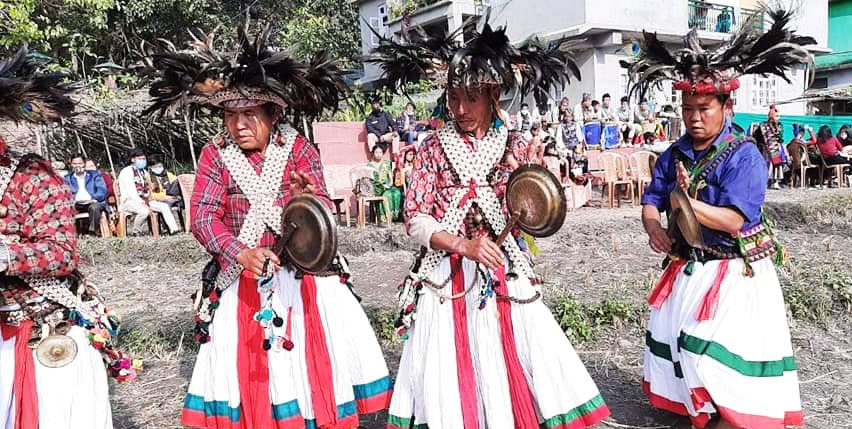
Yet, it’s impossible to ignore the influence of other religious traditions, especially Buddhism and Hinduism, on Tamang shamanism. Hindu deities like Shiva and Kali have found their place in Tamang rituals, while Buddhist concepts like karma and rebirth shape ceremonies for the departed. Tantric practices have also left their mark, particularly in the use of mantras and the belief in energy centers akin to chakras. This syncretism has enriched Tamang shamanism, but it has also led to shamanism being marginalized as a “primitive” practice.

For modern Tamangs, shamanism is a powerful link to their ancestral roots, providing not only spiritual guidance but also a sense of identity. It continues to address the challenges of rural and semi-urban communities, offering healing and wisdom deeply tied to their worldview. Tamang shamanism, with its rich oral traditions and spiritual practices, ensures that the cultural heritage of the Tamang people will continue to thrive. The Bombo, in collaboration with the Tamba (or Ganba)—the traditional storytellers who preserve clan genealogies and cosmogonic myths—are the guardians of this sacred knowledge. Together, they protect and nurture the Tamang identity, ensuring that the wisdom of their ancestors is passed down for generations to come.

As healers, mediators, and cultural guardians, the Bombo exemplifies the enduring relevance of shamanism, answering humanity’s spiritual and existential needs. Preserving this tradition is not merely about safeguarding the past; it is about ensuring that the richness of the Tamang worldview endures—not only for their community but as an invaluable part of global cultural heritage. In a world of constant change, Tamang shamanism offers not only a vital framework for cultural survival but also a “decolonized perspective”—one that reimagines the world through a lens of spiritual interconnectedness, resilience, and ancestral wisdom.